
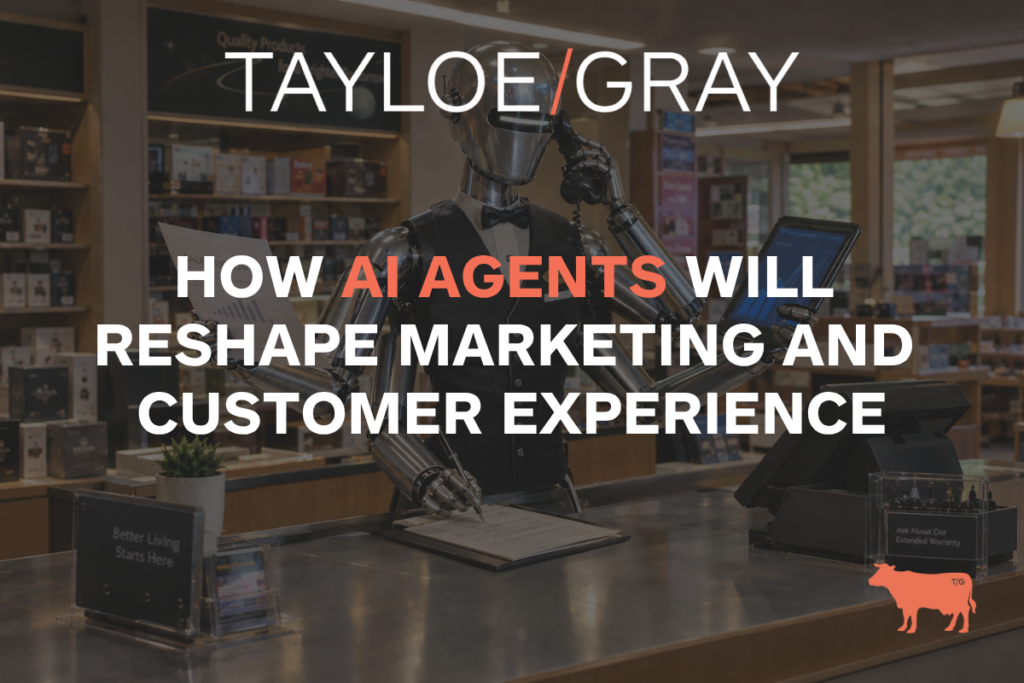
For the past few years, most conversations about AI have centered on content generation.
Businesses have experimented with AI-assisted writing, image creation, chatbots, and automation tools designed to improve efficiency. While these technologies have had a significant impact, they may ultimately be remembered as the first phase of a much larger transformation.
The next evolution is already taking shape: AI agents.
Unlike traditional AI tools that respond to prompts, AI agents are designed to take action. They can complete tasks, make decisions within defined parameters, interact with multiple systems, and carry out multi-step processes with limited human involvement. While the technology is still developing, many experts believe AI agents could become one of the most significant shifts in business operations since the rise of cloud computing.
For marketers and business leaders, the implications are substantial.
What Are AI Agents?
At a basic level, an AI agent is software that can perform tasks on behalf of a user or organization.
Instead of simply answering a question, an AI agent may be able to research vendors, schedule meetings, qualify leads, update customer records, generate reports, or manage portions of a workflow. The defining characteristic is action.
Think of the difference between asking an AI tool to recommend restaurants versus asking an AI agent to compare options, make a reservation, add it to your calendar, and notify attendees.
The first provides information. The second executes.
That distinction has the potential to reshape how customers interact with brands and how businesses operate behind the scenes.
How AI Agents Could Transform Customer Experience
Consumers increasingly expect convenience. Every year, expectations rise around speed, personalization, and accessibility. AI agents have the potential to accelerate all three.
Imagine a customer visiting a website with a specific question. Instead of navigating multiple pages or waiting for a response, an AI agent could instantly provide relevant information, recommend a solution, schedule a consultation, and send a confirmation email.
The interaction becomes more seamless because the customer spends less time searching and more time moving toward a desired outcome.
Potential applications include:
- Personalized customer support
- Appointment scheduling
- Product recommendations
- Service inquiries
- Order tracking and updates
- Guided purchasing experiences
The goal is not to remove human interaction. The goal is to remove unnecessary friction.
What This Means for Marketing Teams
AI agents are likely to influence more than customer service. They could reshape how marketing teams execute campaigns, analyze performance, and manage operations.
Tasks that often consume valuable time may become increasingly automated:
- Campaign reporting
- Audience segmentation
- Lead qualification
- Competitive monitoring
- Content distribution
- CRM management
This creates opportunities for marketing teams to spend less time on repetitive processes and more time on strategy, creativity, and customer insight.
The organizations that benefit most may not be those that automate everything. They will be the ones who identify where automation creates meaningful value without sacrificing quality or customer trust.
Why Human Oversight Still Matters
Whenever new technology emerges, there is a tendency to focus on replacement rather than enhancement.
AI agents are powerful, but they are not infallible.
Brand positioning, strategic decision making, customer relationships, and creative problem solving still require human judgment. Context matters. Nuance matters. Trust matters.
The businesses that successfully adopt AI agents will likely use them to support people rather than replace them.
Much like AI-generated content, the strongest outcomes often come from a combination of automation and human expertise.
Preparing for an Agent-Driven Future
Many business owners are hearing the term “AI agents” for the first time. Others assume widespread adoption is still years away.
The reality is likely somewhere in between.
The technology continues to evolve rapidly, and while many capabilities remain early-stage, organizations should begin evaluating where AI agents may fit into their operations. That does not mean rushing to implement every new tool. It means understanding how customer expectations are changing and identifying areas where automation could improve experience, efficiency, or scalability.
A useful starting point is to ask a simple question: What repetitive processes consume time without creating meaningful value?
The answers often reveal opportunities for future automation.
What Businesses Should Do Now
Every major technological shift changes the way businesses operate and the way customers interact with brands. AI agents appear poised to become one of those shifts.
While the long-term impact remains uncertain, the direction is becoming clearer. Customers will increasingly expect faster answers, smoother experiences, and more personalized interactions. Businesses will look for ways to deliver those experiences without dramatically increasing operational complexity.
AI agents offer a path toward both goals.
The organizations that begin learning, experimenting, and planning today will be better prepared for what comes next.
Ready to Prepare for the Future of AI-Driven Marketing?
Emerging technologies create opportunities, but only when they are aligned with business goals and customer needs. Understanding where AI can improve efficiency, enhance customer experience, and support growth is becoming an important part of modern marketing strategy.
Tayloe/Gray helps businesses navigate digital transformation through marketing strategy, customer experience design, content development, automation planning, and performance optimization. Explore our marketing services or contact our team to build a strategy designed for what comes next.